Showing posts with label cell phones. Show all posts

Monday, October 8, 2007

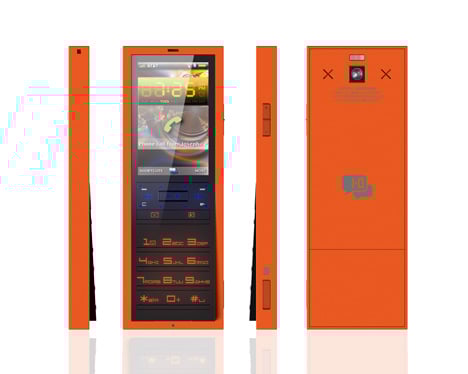
SaY Phone: A Phone For Klutz

Most of us know the dreaded feeling when we drop our phone. Or at least I do because I seem to drop it often… Yea I’m a klutz and I always wish cell phone manufactures would build a phone that was more durable, one that could take the beating of my lifestyle. Throw in a backpack, toss into the car center organizer, and drop it from juggling too many objects at once while trying to talk on the phone.

One company has figured out that a durable phone needed to be made and so SAY came up with the SaY phone. The SaY phone has a rubberized exterior that makes it resistant to drops and bumps. It features include a 4 mega pixel camera and a pair of stereo speakers to annoy everyone with your latest MP3 Justin Timberlake ringtone.

No idea how much the phone is and I couldn't locate a shopping area to learn the price. But if it's affordable, I'm a buyer!


SOURCE: Yanko Design

Monday, October 1, 2007

BetaVoltaic Power-Cells

Laptops may potentially have a continuous power battery that will last longer than the laptop itself by 30 years … and do it without a single recharge. The U.S. Air Force Research Laboratory is funding a research project regarding a new battery technology. The breakthrough betavoltaic power cells are constructed from semiconductors and use radioisotopes as the energy source. As the radioactive material decays it emits beta particles that transform into electric power capable of fueling an electrical device like a laptop for years.

The new battery technology doesn’t use a chemical processes to produce energy which mean it does not produce any hazardous waste. How it works is a little beyond my technology ‘know how’ but the size of the batteries looks to be quite small and thin. An absorbent silicon material is used to collect the hydrogen isotope tritium, which is generated in the process. The reaction is non-thermal which means laptops and other small devices like mobile phones will run much cooler than with traditional batteries such as the lithium-ion power batteries. The reason the battery lasts so long is that neutron beta-decay into protons is the world's most concentrated source of electricity, truly demonstrating Einstein’s theory E=MC2

Environmentalists should be thrilled at the prospects of the new technology. When the new batteries eventually run out of power they are non-toxic.

Source: Next Energy News

Wednesday, March 28, 2007

Development of Plastic Based Chips

One of the biggest problems of cell phones & iPods is being dropped to the ground and no longer being anything more than an ugly paperweight.

The chip inside cell phones & iPods contain electrical pathways that send signals throughout the device. After a device pavement bounce these pathways are sometimes permanently disturbed making the device unusable. I say sometimes, because I’ve dropped my cell phone more than a couple of times and thankfully, they still work. However, dumb things happen and too many bounces or a dumb enough act of destruction can enable a device completely useless.

An emerging technology that is trying to solve this is problem is plastic. Plastic can absorb shock but they are not good conductors of electricity. Plastic Logic, a new company, has developed a patented technology that allows manufacturers to print plastic onto a polymer substrate. The result is a plastic-based transistor that is inexpensive and flexible.

Paulette Prins of the Delft University of Technology has extended the research of useable plastics and has rebuilt the chain in plastics to form a ladder-like structure. This new plastic can conduct electricity in a much better way which makes these chips an alternative of silicon chips.

The technology could drastically reduce production costs and consumer costs, because plastics is more stable than silicon. In addition, the plastic chips could mean that manufacturers of what is called TFT (thin-film transistor) flat-panel screens and televisions, which currently use a traditional silicon-based transistor for each pixel, would be able to switch to much cheaper chips.

Ideas Rule The World